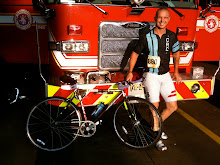
Tuesday, February 16, 2010

chicken scratchings, preamble

I'm also still waiting for the Jihadist Trojan Horse at 1600 Pennsylvania Ave. All the hot whispers of nefarious Muslimity w/ Obama; the Birther nonsense... It's all bullshit but there's no follow-up. The 'news' agencies do not interrogate the blatherers and participate in the perpetuation of disinformation or blatant stupid dishonesty. It's not far off from the supermarket glossies splattering their covers with Angelina/Brad turmoil specials three weeks a month, then being surprised that the couple IS stressed by endless intrusive tensions.

Binary reduction doesn't simplify: it allows/causes cognitive dissonance. More to follow. I'm sure there's bated breath

Wednesday, February 3, 2010

Isn't absurdity situational by definition?

When I was a rookie, I frequently bemused myself with the running monologue of what seemed natural to me that was clearly either verboten or demi-social suicide with my new 'brotherhood' of firefighters. Such as being a vegetarian in the world of meat-and-potatoes and reactionary, muscularly anti-sensible eating habits. Or being friends with my wife. Or despising the moronic drivel of KQ's morning show, which was, and remains, the fount of witty shop-talk for most 'blue collar' dudes. My left-leaning, anti-racist, multi-lingual personality rendered me suspect--at best. As did having a degree. And having been a teacher (not a carpenter) prior to being hired.

Which is pretty much bunk. Many of these folks are very smart, intelligent, educated...they choose to be the way they are (disproving that a healthy dose of liberal pablum washes away all 'wrong-headed' impulses).

My vocabulary has always been strange. Read too many books when I was young--but never learned to pronounce things correctly. I read the dictionary for fun, then revisited it after reading Autobiography of Malcolm X. I saturated myself in Beckett and Joyce and Woolf and Faulkner. Oh, there was Faulkner in the bloodstream back yore, when polysyllabic miles-long sentences mixed with booze and despair. Even when I was teaching, my word choice has been arcane and my thought process as effortlessly prolix and circumlocutory as they come. Working with guys who were rigidly anti-intellectual heightened my awareness of toning it down, or providing definitions reflexively, seamlessly, without making anyone feel condescended to. I never talk down to people, but I'm a dork.

Racing up the street one morning before dawn, to what turned out to be my first full fire, I marveled at the descending moon in the summer sky. We reached the corner, saw the three-story house fully involved, and my reveries were broken. Until about two hours later, when we were blasting it still from the outside, several crews actively surrounding the diminished conflagration with multiple hose lines and master streams. The initial adrenalin has subsided, the scurrying actions and tasks have been completed--whether successfully or not remains to be seen--and there's little to do but watch as thousands of gallons of water blast the building.

The burned-out roofline was revealed, and, beyond it, the salmon-pink sky breaking dawn over Wisconsin and bearing down on Mpls. I marveled at the juxtaposition, thrilling at my new job and the crazy wonders we experienced, and as I stared at the blackened, smoldering shell of the house and the sky showing through its skeletal frame, I paused. Searching my mind for a term, I flipped through images from lit. classes over time, trying to capture the context for the word, the term, the setting. I turned to the guy next to me, 'Hey, you know what they call a poem written about dawn?' I could almost see the word, form it on my tongue. 'Like, a poem about morning breaking, or the end of night--generally a romance poem, of lovers parting and one walking the streets, heart and or loins full of the previous night--or what is lost or missing...' I trailed off. The firefighter stared at me. 'What the fuck are you talking about?' I actually tried to explain again, then caught myself. 'Nothing. Just some shit passing through my brain.' He laughed. I laughed.
As we were picking up hose, soaked and sweaty and filthy and beat, I smacked a mosquito on my wrist, splattering its (my) blood in a smear of soot and mud. Aubade. I said it aloud, to no one by the dawn and the remains--soon to be bulldozed--of the house: 'Aubade, a poem to or of the dawn.'
Word.

Thursday, January 28, 2010

Celestial Myopia

From James Wood, in the NYTimes:
Terrible catastrophes inevitably encourage appeals to God. We who are, at present, unfairly luckier, whether believers or not, might reflect on the almost invariably uncharitable history of theodicy (the justification of God's good government of the world in the face of evil and pain), and on the reality that in this context no invocation of God beyond a desperate appeal for help makes much theological sense. For either God is punitive and interventionist (the Pat Robertson view), or is as capricious as nature and so absent as to be effectively nonexistent (the Obama view). Unfortunately, the Bible, which frequently uses God's power over earth and seas as the sign of his majesty and intervening power, supports the first view; and history of humanity's lonely suffering decisively suggests the second.

Melville's Moby Dick, Captain Ahab:
All visible objects, man, are but as pasteboard masks. But in each event--in the living act, the undoubted deed--there, some unknown but still reasoning thing puts forth the mouldings of its features from behind the unreasoning mask. If man will strike, strike through the mask! How can the prisoner reach outside except by thrusting through the wall? To me, the white whale is that wall, shoved near to me. Sometimes I think there's naught beyond. But 'tis enough. He tasks me; he heaps me; I see in him outrageous strength, with an inscrutable malice sinewing it. That inscrutable thing is chiefly what I hate; and be hte white whale agent, or be the white whale principal, I will wreak that hate upon him. Talk not to me of blasphemy, man; I'd strike the sun if it insulted me. For could the sun do that, then I could do the other; since there is ever a sort of fair play herein, jealously presiding over all creations. ...Truth has no confines.

If on one hand, we cannot know or fathom the whims and plans of god, why do so many leaders and believers so quickly turn to rationale that are so patently human- and earth-based? Why would the most powerful, all-beyond-knowing-supreme deity need to rest on Sunday? That sounds like the words and actions of man projected and stretched upon the theater (or pulpit) wall.

Thursday, January 14, 2010

Belgium & Its Belgian By-Products


While many Americans hear Belgium and chuckle, the word and country serving as punchline or waffle antecedent, in a few highly specialized sub-sub-subcultures, the word connotes mastery and apex of performance. We odd-balls are transfixed with awe at the spiritual and literal home to our respective obsessions.

I’m referring, of course, to the twin sports of cyclocross and ringsport. Both are hybrids or amalgams of other sports--neither of which would fill a sidebar in Obscure Sports Quarterly on these shores, but both receive intense, widespread attention, support, devotion in the land of the Belgians. One deals with people racing their bikes in mud and snow in crazed-fan-crowded maze-like courses. The other is a police-dog style dog sport that occurs in fields, parks, and stadiums with fans surrounding and abounding. Belgian beer and knee-high mud boots are commonplace on the fans. This will be a brief, utterly unscientific examination of these odd activities that should be required for all...

I’ve spent several years learning and training in competitive dog sports, and have moved from the so-called personal-protection events (which can be back-alley scare-fests or dubiously organized ‘street-scenario’ competitions) through Schutzhund (German military/police K9 test; most well-known and practiced in the USA) to French Ringsport and Mondio Ringsport (which is a combination of the French and Belgian programs; Belgian ring itself is dying out in the home country, replaced by Mondio). While the French have the advantage with French ringsport, and the finessing of the rules has a very French flair, Mondio combines aspects of several programs.

Briefly, there are obedience components: heeling, retrieving, scent discrimination, exercises the dog must complete away from the handler--you can give one command and the dog must know what to do. There are agility components: a four-foot hurdle; a seven-plus foot palisade; a 12+ foot long jump. And there are the apprehension, or biting, exercises--which is what separates these dogs from, say, a long-jumping Labrador. Each of the biting exercises originated as a specific part of a K9's duties: chasing after a fleeing bad guy; going after a bad guy over a distance, and then again when the bad guy is wielding something to protect himself; searching for a hidden bad guy; guarding/escorting the bad guy as he schemes to escape; guarding something 'valuable' while the handler is out of sight. It takes years of training to successfully train a dog to do all of these well. And, the dogs must start AND stop biting on command.


It is colorful, ‘easier’ to enter but quite difficult to master, more spectator friendly than other sports, played well in Belgium by Belgians. Americans lag far behind, in terms of experience, numbers of participants, skill set, training, understanding, and fans.

Gee, sounds very much like cyclocross.
(great reference site; usmondioring.org; cxmagazine.com)

My good friends Dan Casper and Linda Sone are ardent competitive-amateur cyclists. I started watching them race, as it was the only way to spend time with them. First, this summer at the NSC Velodrome, then at a few of the road races, and then, all fall, at the MN/Wisc cyclocross races.

Cyclocross also has deep roots in Belgium, with the predominant racers and races spawned by the black/gold/red. It seems to be a hybrid and combination sport: modified road bikes racing off-road. Dismounts, running up hills, over logs and barriers, carrying the bike, racing in mud. Things that road bikes, and road bikers, aren’t good for/at. Belgian Glory.

With both sports there is a particular sensibility that distinguishes its players, and the game itself, from its antecedents or kissing cousins. Cyclocross has cowbells and smart-alecky humor, creative taunts and heckling from the peanut gallery, not to mention beer and dollar handouts along the course.


It’s hard, rowdy, rollicking good times, played to the crowds on purposely difficult course arrangements. Blood, sweat, & beers/gears... Mondio ringsport has goofy themes for each competition (‘Night at the Museum,’ ‘Kitchen Sink,’ ‘Birthday Party,’ ‘Alice in Wonderland’), with the decorations, props, decor, accessories integrated into the theme. Cyclocross has the colorful kits and self-deprecating humor. Mondio decoys have colorful bitesuits (as do all the ringsport decoys) but also face paint, masks, costumes as well.

For many American cyclocross riders and Mondioringers, Belgium looms as a mythical land, where around every corner is a gorgeous field full of top level dogs and decoys, and just beyond the hedges is a winding, tree- and hill-strewn cycling course--both chockfull of fans. Not just for American tyros, either: many countries where these sports are less developed must view the proximity and saturation of Belgium with longing and awe.

Several very good French ringsport decoys (also known as malfaiteurs, hommes de ataque, bad guys) absolutely flub in Mondio, because there’s room, and demand, for creativity, sense of humor, imagination that isn’t required in French (and certainly NOT in the Teutonic, rigid Schutzhund). A Mondio program held on two consecutive days on the same field can be radically different in appearance, order of events, difficulty. Schutzhund and French ring players get thrown by all the distracting decorations on a Mondio field, as well as the ever-changing components to the standard exercises. Their fields are ‘sterile’ and the programs always follow the same pattern. In Mondio, there are props and accessories and strange objects that are essential to the trial--much the same way that runups or barriers aren’t just something to harass road bikers but an essential part of the discipline. I train my dog for Mondioring and he will retrieve anything I tell him; in Schutzhund, it’s always a wooden dumbell, and in French ring it’s a balled up sock (as if that is normal). We have toys and lawn ornaments and dog treats littering the field: on purpose. It’s very fun to design a Mondioring field and trial: fulfilling the required exercises with creativity AND fairness, making mental challenges for the handlers as well as training challenges for the dogs.


Very much like the flexibility and creativity involved in setting cyclocross courses. Road purists don’t like the mud, the running, the off camber; mountain bikers don’t like the flat portions. It would seem to favor mountain crossovers. Many road races shy from cyclocross for the very things that attract other races: strange angles, random dismounts, carrying the bike, portaging the bike over barriers or up hills. Cowbells. Laughter. Beer.


American Mondio Ringsport is played by a very small percentage of all the dozens who train and compete in K9 dogsports. The sport has been growing, but we are so spread out that the numbers are diluted, which makes training, and competing, difficult. Three clubs in Texas have about twenty active members, but they are spread across Texas. California has players spread along I-5, but it’s a really big state. A smattering in the Northeast, and half-a-dozen of us in the Minnesota/Wisconsin border region (again, a five-hour drive to get together to train together). My Belgian friends say the internecine politics and backbiting is the same (dog people are famously deficient in human skills) but they only have to drive an hour to train with any number of people in other clubs.

We are making progress, but we lag so far behind, and lack so much in numbers and opportunities that we’ll be the red-headed stepchild for a while.

The very best American cyclists train and compete in Europe: it’s bigger, faster, more serious. A proving ground. Those doggers who can afford it and are dedicated enough go to Europe; they go to France to train French ringsport, and they go to Belgium to train Mondioring. In a weekend, they can visit over a dozen clubs with dozens of top-level dogs: more than they’d encounter in five years here. The race season across Belgium is chock-full of events. We try, but we’re so far behind. For a nation of our size and resources, if we invested a smidgen of time, money, energy, we could speed up the process, but we’d lag behind in terms of the spirit and essence. It's like biking, with running hills thrown in, and mud. And cowbells.

The most successful dogs for ringsport are the Belgian Malinois, which is the main type of Belgian shepherd. The others are the Turvuren and Laekenois. Or the Groendal. Imagine my surprise and thrill when following European cyclocross online and seeing so many of the same towns hosting races. Does every Belgian family have a wonderful Belgian shepherd sleeping by the fire and three little hearty cyclocross junior racers around the table, eating waffles? It must be, right?

The Malinois has replaced the German shepherd (which is largely a ‘German’ shepherd by way of the old Czech Republic) as the choice dog for military applications. Mals haven’t been ruined by the power of the show breeders, so their temperaments and performance haven’t been sacrificed to an arbitrarily assigned conformation, or look. The roached back of the German shepherd, like the hyperbolic big heads of bulldogs or smushed noses of pugs, have been assiduously bred for looks’ sake only: there is nothing functional about these shapes; in fact, they are detrimental to the dog’s well-being. The Malinois was the Belgian farmer’s dog for years. There was no money or interest in making them fancy or designer. They could be anywhere from 25 to 100 pounds. ‘As long as it works like a Malinois, it’s a Malinois,’ was the reasoning. They are like a cross between a fox, a squirrel, a bag of crack, and a badger. Very twitchy and fast-response; very, very reactive; very biddable; crazy drive and endurance.

When speaking with Europeans, and Belgians in particular, in either of these disciplines, their perspective on the U.S. competitors is consistent. Mildly patronizing and dismissive of us for being too new and inexperienced, yet they also admit we are making strides. The Belgian decoys and judges I’ve worked with at U.S. mondio trials have been complimentary of our progress. Individual dogs and handlers have begun to make respectable showings on the European stage. This is very similar to our progress in Cyclocross. They generally dismiss us as a group for being less-skilled, less-focused, lacking in some essential work ethic, yet acknowledge that individual racers are making headway toward the podium.

In Belgium, the dog clubs meet four or five days/nights a week. Their clubhouses are elaborate, with kitchens and well-stocked bars. It’s a cultural & family thing, albeit atavistically traditionalist: the men train dogs and talk dogs while the women tend bar, kids, and male egos. More women are handling and judging these days, but old attitudes are ingrained. They have oodles of dogs to train new decoys on; they have oodles of handlers who have trained multiple dogs to championship level. Many have grown up at the training club. It is generations deep. Likewise, cyclocross has been established and ingrained in Belgium for several generations of cyclists. It IS part of their culture and heritage. No wonder we are small fish swimming blindly in a big pond.

Now, if we could only create a state of cyclocross for the U.S., with the mud and fervor of Portland (and the drum corps), the ice & snow of Iowa/Minnesota/Wisconsin, the sea and sand of Gloucester, the forests of California... Similarly, if we could cram all the Mondio-ringers into a small dog state, with less extreme heat than Arizona/Vegas/Texas and none of the glacial nonsense of Wisconsin and Minnesota--and then get all the crazy dog people to get along... Oh, yes, that...

Thursday, January 7, 2010

'Does your dog bite?' 'No.' /growl. snap/ 'I thought you said your dog didn't bite.' 'Madam, that is not my dog.'

I was wearing a US Mondio Ringsport hat today and someone asked what the logo meant. The easiest shorthand is to say, 'I work with civilian K9 teams, doing police-style sport competitions.'

Huh?

Most of the so-called protection sports derive from one of the European military or police K9 suitability tests: Schutzhund for those zany Germans; French ringsport for the aesthetic French; Belgian ringsport for the Belgians. KNPV for the Dutch. Mondio Ringsport was devised as a way to cross boundaries between sports. These all require a dog & handler team to perform a range of obedience exercises, scent discrimination tests, retrieves, agility/jumping exercises, and then bitework, or apprehension.

As with many sports, the 'real world' applications and origins have faded or been eclipsed as training and performance have improved. What used to pass for top-notch heeling, say, would barely be considered sufficient now. Which isn't to say that it wasn't functional heeling before: we've just put so much time, thought, and training into all facets that these tests are now highly nuanced: goals in themselves, rather than approximations of actual police work.

I maintain, though, that the training skills we develop would more than benefit 99% of the police K9 teams in the US.

Check out leerburg.com for a vast website loaded with information about training and the various dog sports.

HOW did I get into this? I blame the clicker mania of the mid-2000s... Poor training ran me out of the local pet obedience classes, and I stumbled into a breeder & trainer who specialized in home guardians. I was captivated at the amount of skill/talent the trainers had, putting the various dogs through their paces (for most of us who have had untrained, beloved dogs forever, seeing dogs with snappy, intense focus is daunting). We agreed that my dog didn't have much for even basic obedience, but I wanted to learn more about serious training. Then they asked if I was afraid of dogs. I said no. They put me in a bite suit and told me to charge at their dogs, simulating a hopped-up marauder. The dog defended his handler, attacking me, and I simulated fighting and screaming.

I am a clown, I like to learn and to teach, I enjoy the physical challenge of working dogs. So there I was and here I am. Many of the truly advanced sport dogs would likely not attack someone who broke into their house: the context is wrong. These are sport dogs: it is a game to them, and without the context, the clues, the game, there's no reason for them to bite. This is oxymoronic, given that the entry level dogs are usually defensive and prone to seeing everyone unfamiliar as a potential threat.
When we train, there are people all over the field, and it's clear to the dogs who the 'bad guy' is (he in the puffy suit). I prefer it that way.

The internet is filled with endless arguments about 'real' dogs vs. sport dogs. Blah, blah, blah. Return of the Jedi vs. Phantom Menace. Whatever. Very few of us has any actual need for a hair-trigger attack dog at the ready.

Tuesday, December 29, 2009

run-up to amateur night #1

I worked three of the final five days of Xmas. For the first time in several years, we had neither a suicide nor tragic death, nor a last-minute fire to ruin a family's holiday. So that was good.

Things I will leave blank since it's obvious what venom would follow:

idiots trying to blow up planes...
the illogic of the travel-safety oxymorons in after-the-stampede barn door shutting...
holiday travel in general, dubious logic of
stress and its malcontents
the pleasantries of getting where you're going and being with your people
'black' Friday (yes, that one STILL has me fuming)
the folks who've turned street-plowing into a devilish torture of those they're 'helping.'
chopping ice to protect people from falling down 13% grades to the sidewalk from the ice floe on my curb...
getting a nasty gram from the city seven minutes after the trash truck has complained that I hadn't shoveled a wide-enough lane, yet no love at all when their plows make the sidewalks/curbs/alleys inaccessible...

My first New Year's Eve at Station Five, we tailed a drunk driver, giving Dispatch updates of the driver's location. She asked, finally, if we were following the driver in our fire truck. 'Um, ... no...' Several hours later, we spied a drunk face-down in the snow outside the station. We went to check on him and called a squad to get him to detox and a warm bed. He was bemusedly belligerent and foreswore our help. Then he fell again and proceeded to crawl along the frozen, icy ground. We tried to help. He mightily fucked us off, so we let him be, standing across the street. If not for the pathos, it would have been humorous: his deliberate, almost campy insistence on crawling across the street--to spite us, he said. Except he couldn't crawl up the two-foot snow/ice drift. Up and down, up and down, up and down: he crawled up then slid and rolled back down. We went to help him when he rolled into the street, for fear a car (likely driven by a drunk) would crush him, thus ruining his awesome plan to spite us. Finally the police squad approached and our man jumped up and began waving impatiently for the cop. 'About fucking time,' he said. We looked at each other: rarely do people, no matter how drunk, diss us for the po-po. He told us off and started to tell the cop about how shitty we were. The cop sidestepped his embrace and slammed him against the hood of the cruiser, frisked him, and shoved him into the backseat. THAT'll teach him to spite the best non-judgmental social service he's got at two a.m. on amateur night... No love for the cats in blue, eh?

Sunday, December 20, 2009

Ammoniac reveries

When I became a firefighter, I had a rough idea of what the job entailed. I knew that Minneapolis, like most cities, had drastically fewer fires than in the past. I knew Mpls firefighters responded to medical calls.
It takes a long time to really learn how to fight fires. Truly a hands-on job, with the caveat that to learn well, one should also get good, instructive post-fire explanations and evaluations to better understand what exactly happened in the dark and the smoke. This is not often the case, so there are many people very skilled at doing the same thing they've always done: floundering about in the dark. I have many extensive thoughts and opinions about this crucial flaw in the traditionalist learning process. Another entry...

During rookie school we went on ride-alongs with Hennepin County paramedics. My first one, on Friday night, 1 April, 2000, we had a range of calls. One was a young Latina who was pregnant and scared. Neither of the medics spoke any Spanish. I do/did, but I wasn't up on my Spanish medical vocabulary. 'Pre-natal care'? 'Months since last menstrual period?' 'Complications?' 'Allergies?' etc. It was comic and painful. After a decade, I'll still have catastrophically inept conversations, generally at middle-of-night calls when I'm barely coherent enough to make clear English sentences, let alone wrap my salty tongue around Spanish idiomatic expressions.

We toured the ER, too. Learning about how it worked and interacting with patients. It's important to be able to touch people in this type of work. You wouldn't necessarily think about it, but we spend a lot of time in people's personal space, pulling up or off their clothes, helping them when they've fallen in the bathroom, etc. In the STAB room that day there were a couple acute cases. The STAB room is where critical or marginal calls come before either being dead or going to surgery or ICU. There were a couple heart attack people, and a mother-daughter pair who'd been in a car accident. The mother hadn't been seat-belted and had tossed around the car when it rolled, resulting in neck and head injuries & lacerations, teeth knocked out through her lips, and a broken ankle. Her daughter was belted. She had trauma from her mother smashing her as the car rolled. If both had been belted, this wouldn't have happened. The daughter's left arm had been snapped, however, when the car rolled--caught in the open window and the ground. We were watching through the overhead monitors as the doctors and nurses work on it, and I was looking at her arm as they cleared the blood and broken skin away, showing the protruding top half of her broken humerus bone (upper arm). I turned very, very pale. I stepped back and sat on a chair. The paramedic leading our tour did a double-take, grinned, and got me some water. My two classmates were utterly supportive. Not.
So, I know I don't like to see exposed bone without preparation. On calls, at least, we have a general idea of what we're going to, so there's a chance to anticipate all the potential things that have happened to the body.

We learn quickly--or we should--how to assess scenes. Asking the standardized list of medical information questions, sure, but also taking in myriad other--often more telling--clues and cues. Unlike the paramedics, our face-time with patients is relatively brief on most calls, allowing us to maintain a warmer, more-compassionate, or at least tolerant, disposition to the endless non-emergency 911 calls. The force of energy shifting from the medics and Fire when we respond to a 'possible heart attack' call and a guy is sitting in his armchair, breathing fine, full of healthy, oxygenated blood (but for his smoking habit) and says he's had a cold for a week and had a pain in his back, near his heart, ie, on the left side of his body, for about a week. And then he says it's about a nine on the 1-10 pain scale.

We have seen horrible trauma. I NEVER NEVER NEVER want to get to a real-scale level nine or ten. Never. When I strained my lower back at work and couldn't bend w/o a sharp, shooting pain, I told them it was about five. When I dislocated my shoulder, sabotaged by physics and gravity while biking in the snow, I was gasping with the surges of pain, but that was about four. I'm superstitious like that.

Blood, open wounds, viscera aren't as bad for me as the bone playing peek-a-boo through the ruptured flesh.

What they didn't prepare us for in rookie school was the smell. Or, smells.

Gastrointestinal bleeds involve the body turning septic from within, and the patient vomiting and shitting rancid bloody liquid. That has a singular, potent odor.
Nursing homes smell of old people, urine, and bleach.
Drunks can smell really rank, and we get Listerine or paint thinner mixed with that.
Vomit is vomit is vomit.
Shit is shit, by the way. A drunk on a binge who's been drinking and shitting herself for three or four days is going to smell similar to the poor old fellow who fell and couldn't crawl to the phone so lay on the floor for three days, shitting himself.
Incense that covers dope smoking.
Pungent spices of ethnic food; those same spices and foods when the stove has been forgotten and the entire building is choking with acrid burned whatever.
Septic wounds.
Decomposing bodies discovered after a couple days, of course.

The smell that made me want to demand a training warning in rookie school is this: the accumulated reek of long-time urine soaked into clothing, skin, furniture. There's a heavy tang of ammonia that digs deep into one's eyes, nose, and stomach. The stench comes from everywhere, not just the person or his/her clothes, but the rug, the couch you're leaning on to help lift the person up, the air is heavy with this. Which is why nursing homes use so much bleach.

There are many, many calls we return from with sour expressions and unshakeable visceral sensations in our noses, mouths, minds.

And we sit back down and eat our dinner.